Blogs
Aubero Fall 2026 Menswear Collection
Jan
On a display table within the Aubero showroom space were objects that held personal significance for the brand’s founder, Julian Louie. Two ceramic bowls made by his grandfather were filled with sea glass collected by his mother. A small pile of rocks embedded with shell fossils—“It’s like holding time in your hands,” he mused—were his own, found on the beaches of Santa Cruz near where he grew up.
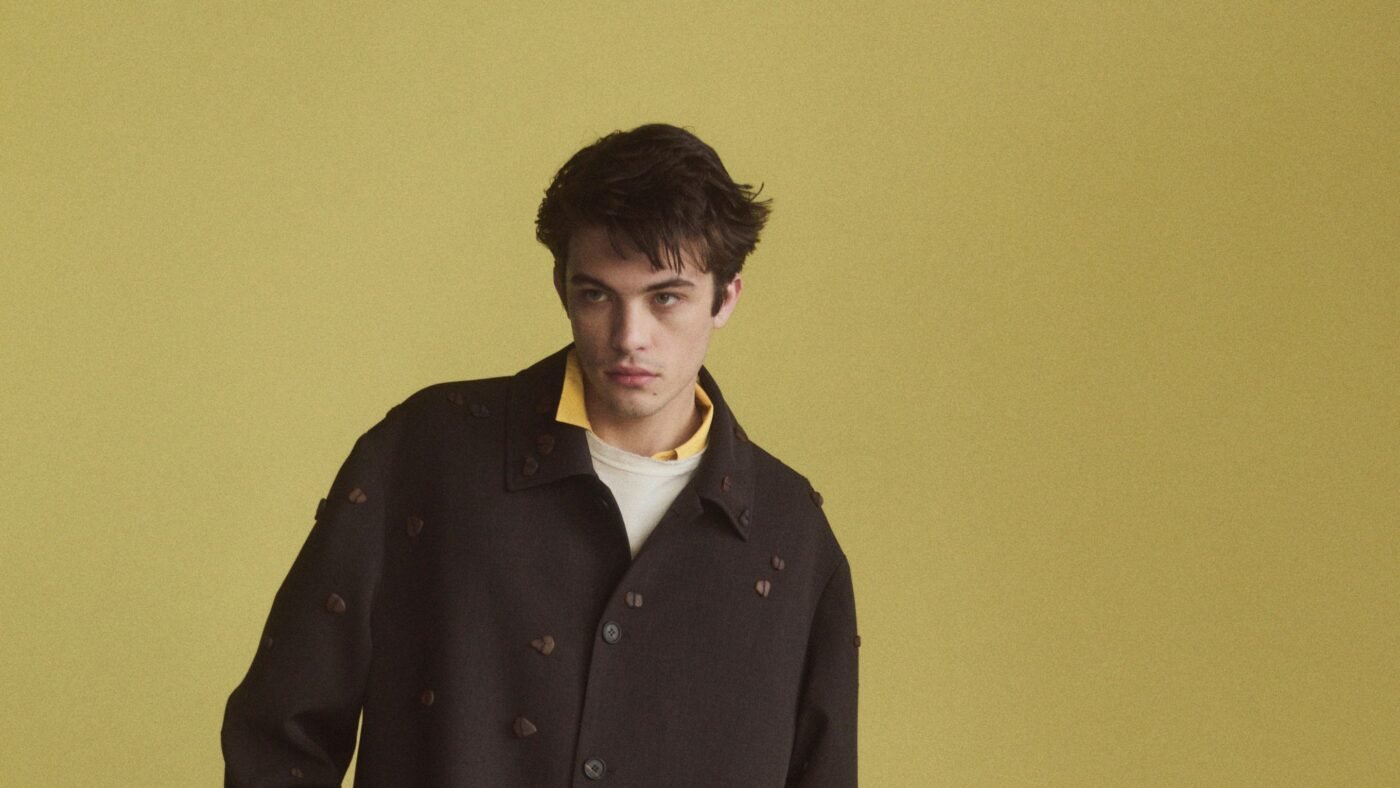
Louie has imbued Aubero with thoughtful originality based around the longevity of materials from day one. Four years and many exceptional, one-off designs later, his dual interests in collecting and craft are now visible across a greater range of garments that reflect what he described as “the stylistic stance of California”—only that he’ll reinterpret a checked flannel shirt in silk taffeta and Dickies-style pants with a dropped rise and articulated buttons in satin duchesse. He has introduced a few sweaters made in Bolivia (everything else is made in America) as “an overture” into knitwear, coinciding perfectly with this general menswear trend and clever from a commercial perspective.
In the realm of his labor-intensive output was a tailored black coat in fragments of natural fabric from every season including pre-Aubero when he was working with material at Desert Vintage (the cult Arizona shop that opened an outpost in Paris last year). His mother, in addition to being a writer, hand-stitched the garment like a dimensional collage. And he returned to his signature “caging,” the five exposed layers like ghostly traces within the sleeves of an otherwise streamlined jacket.
The small irregular pebbles of sea glass that adorned a black zip-front jacket and a white-button front shirt had organic, artisanal appeal that illustrated how a kind of baroque opulence can resurface in a contemporary context. These instincts also guided him to embellish a sheer black tabard with tonal embroidery and to construct a coat collar from a fine arrangement of vintage ties. The pursuit of distinctive details even extended to Aubero jersey with its rolled edges. “It was not about making something that’s distressed,” he explained. “It was really more about this kind of strange detail that happens only through wear.”
Back to the display table, which featured two bags made from deadstock raw silk, softly ribbed with a spectrum of color. One was a compact drawstring shape; the other, an ample cross-body style. They will return next season in a different textile. There are now multiple entry points into Aubero; and knowing that Louie remains resourceful across all of them is a satisfying reason to buy in.